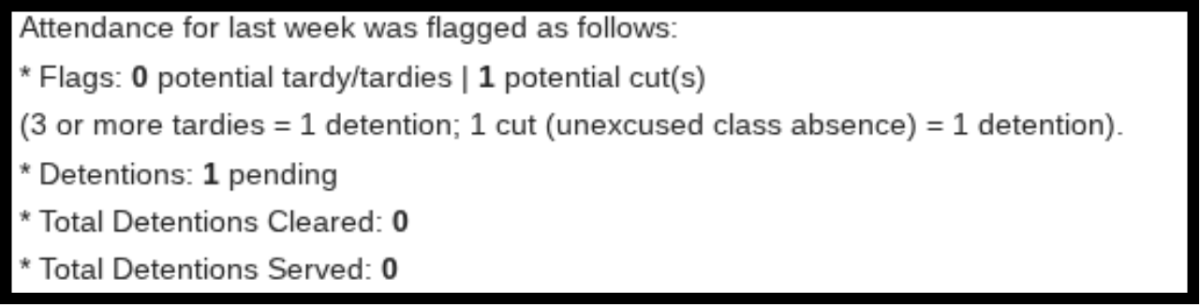
For the 2026-27 school year, the Jones administration introduced a new detention policy: three tardies in a week or a skipped class period will result in one detention with three detentions resulting in a loss of privileges. This new policy was uncharacteristic of Jones, but I did not think much of it. However, when I received an undeserved detention, it became clear that the administration does not know how to accurately regulate the detention policy.
A recent wisdom tooth extraction surgery caused me to be too exhausted to go to school, so I stayed home and rested. I miraculously stumbled down the stairs to my couch where I lay down and got ready to nap. My eyes began to close when I got a ping from gmail. The subject line read “JCP Attendance Notification: Your Child has 1 or more Unexcused Absent Or Tardy.” I sat up and my swollen face disagreed with that movement immediately. Although my mamá filled out the online form for excused absences, we received no response from the main office. Somehow, I still received a detention for “skipping” my seventh period.
The Jones administration gives the impression that they are not fully versed on their own detention rules. When I received my detention notice, there was no deadline for when the detention needed to be served. And yet — according to the discipline team — if a student has more than three unserved detentions, they cannot participate in off-campus lunch, athletics or certain school events. They also allude to other consequences that are not elaborated on. The detention email said, “Accumulating 3 or more unserved detentions will result in a loss of privileges, including…” and list off the aforementioned items. However, they do not include a link of other privileges that will be taken away nor do they mention the specific school events. Instead, students are left to interpret the message and be scared.
At this point, the discipline team lacks structure. The lack of detention deadlines gives students no reason to be scared of it. The policy is counterintuitive. The point of detention is to encourage students to behave. Instead, the lack of enforcement within the discipline team removes all reasons for doing so.
The discipline team needs to make the full list of revoked privileges accessible to students and add an enforced time to detentions. However, forced times for detentions can be difficult for students with extracurriculars. Thus, students will be more encouraged to serve detentions if it is held at accessible times. For example, lunch detentions take small privileges away like socializing instead of requiring the students to sacrifice outside time.
Along with its poor execution, the detention policy fails to solve the underlying issues that cause tardiness and absences. According to Deputy Editor-in-Chief Mira Monar ‘27, “[Detention is] incredibly restrictive and also problematic how it doesn’t consider students’ external circumstance.” Mental health, for example, plays a large role in school attendance. According to a 2026 PLOS One study, The Impact of School Absence on Mental Health in Children and Young People, COVID increased social isolation, pandemic anxiety and family strains. So, disciplining students for bad behavior ignores potential mental health issues that cause frequent absences or tardiness. Instead of immediately punishing students, the Jones administration should refer the student to a school counselor in order to pinpoint the cause of their poor attendance. According to a 2022 Frontiers in Education study, How Effective Are School Professionals at Identifying Students Who Might Benefit From Cognitive Behavioral Therapy, school professionals found their ability to identify students who might benefit from therapy important to improving mental health early on. Thus, school attendance will increase because root issues like mental health can be solved instead of immediately assuming the worst of students.
The establishment of a detention policy has been neglected for a long time within Jones until we were forced to confront it this year. The absence of a serious detention policy relaxed the student body and lifted anxiety off their shoulders. However, this led to an attendance problem at our school. So yes, the detention policy may be helpful for limiting absences and tardies. However, it does not effectively address underlying issues like the discipline team structure or student mental health. The suggested detention edits can work together to increase attendance because deadlines force the disciplinary team to question student mental health quickly and refer them to their counselor where they can be better taken care of.
To make the detention policy more accessible to students, the discipline team should hold a meeting with student representatives to discuss what students need out of it. This way, Jones can develop a fair and organized disciplinary system. As time goes on with a poorly organized disciplinary team, the more students that miss out on vital education.