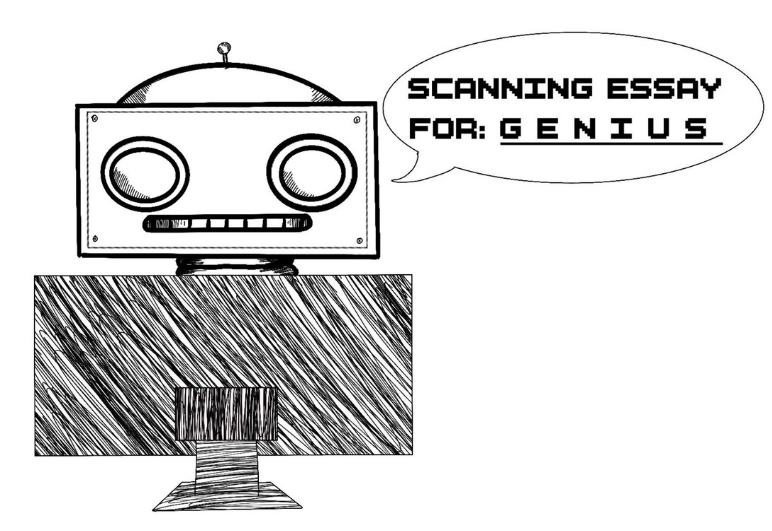
As an academically focused student receives their awaited scholarship essay evaluation, their palms are sweating like never before. As they open their computer, now covered in sweat, their designated evaluator responds to their meticulously crafted essay with a seemingly robotic response. As students applying through scholarships should refrain from using AI, so should their evaluators. AI usage in scholarship essay writing and evaluating eliminates the scholarship’s value. Scholarships live as a prestigious feat for any student to accomplish, and the expectation from students functions as receiving a human-given award. The groups of people that evaluate these essays exist as scholarship committees, consisting of highly educated volunteer judges, foundation board members, school faculty, or organization representatives.
AI tools taking the place of human thoughts out of laziness isn’t fair to the students who get denied those same tools in writing these essays. When writing a completely original essay, students applying for a scholarship work hard to inevitably get judged by an evaluator using AI. Usage of AI eliminates human connection between the student and their evaluator to analyze the importance of various accomplishments that students build.
Disregarding better judgement, some may argue that using AI as a tool is a great way for evaluators to supplement their knowledge with facts off of the internet. As AI is integrated into the scholarship evaluation process, it helps the committee read and analyze many essays in a timely manner. Evaluators can take using AI as a break from doing their hard work that uses lots of brain power. Although this may seem accurate, robots don’t have the same level or amount of information as educated teachers and administrators that have worked hard to get to where they are. According to Kaleidoscope, a scholarship software marketing company, “The conclusions of AI lack empathy and intuition, which are often critical when reviewing applications.” Human evaluation creates an emotional connection between the evaluatee and the evaluator, adding value to the overall process. That necessary human connection is what students appeal to when writing their essays. This is valuable to the process so that the student can attend a college or university that fits them the best, evaluated by human experts.
Scholarship evaluating committees are using AI tools, sometimes acting unreliably. According to the National Scholastic Press Association, scholarship essay evaluators use AI. “From automating eligibility checks to supporting student coaching tools and detecting potential fraud, AI is becoming embedded in modern scholarship administration.”
Evidently, the evaluation committee should evaluate how AI performs the function of distributing scholarships from reading a student’s essay. The procedure posing AI as a tool might appear helpful, but it nonetheless leads the committee to put minimal effort into their job that they get paid to do thoroughly. Rather, the committee should use their prior knowledge and experience to evaluate students’ essays to ensure a thorough procedure.
AI, while considered harmful to the integrity of students’ work, is often used by teachers as a tool to cut corners. AI serves as a tool, used to avoid any mistakes in these letters, regarding deadlines or grammar errors, which can strongly appeal to a busy teacher. Teachers using AI while students cannot is parallel to the committees using AI while students cannot. According to GeekWire, a reliable breaking news in technology site, a prominent Seattle based journalist Nathalie Graham, reports that “Around 31% [of teachers] have used generative AI to craft letters of recommendations for students applying to colleges. They viewed their own use of AI as ethical — a timesaver for an increasingly demanding job — but viewed students using AI as unethical.” This outlines the efficiency that AI grants teachers, but also highlights the hypocrisy that appears as the classroom dynamic, with many teachers finding their own AI usage to work as an ethical tool. Teachers validate their behaviors, but judge their students as irresponsible and lazy, creating a double standard. This recurring double standard of the acceptability of using AI tools is repeatedly negatively impacting students.
Using AI tools for letters of recommendation acts counterintuitively because they should come from human experiences between a teacher and a student to promote furthering their education, so a robot taking charge of this heartfelt interaction discredits the student’s evaluation and shows that the teacher or administrator doesn’t value that human connection. Again, AI tools create lack of humanity, and further lack human experiences, judgment and moral consideration. Evaluators need to use their work ethic and integrity instead of relying on AI, no matter the benefits. Educators need to apply prior expertise to evaluate something as important as scholarship essays.
The expectation embodies that AI works seamlessly and won’t make any mistakes, but that’s not the reality. AI tools that exist as resources aren’t accurate in their prompted work, creating distrust and unreliable products.
These tools do not always positively affect the outcome for the students. Reading many essays for scholarships is a lot of work and feels very time consuming, but it is proven that alternate AI tools aren’t always reliable and because of that, it takes away the high respect for scholarships and students who deserve them. Overall, the use of AI characterizes disregard, but also remains finicky and doesn’t always result in a positive outcome. Anyone who evaluates scholarship essays cannot use AI tools and make reliable insights.