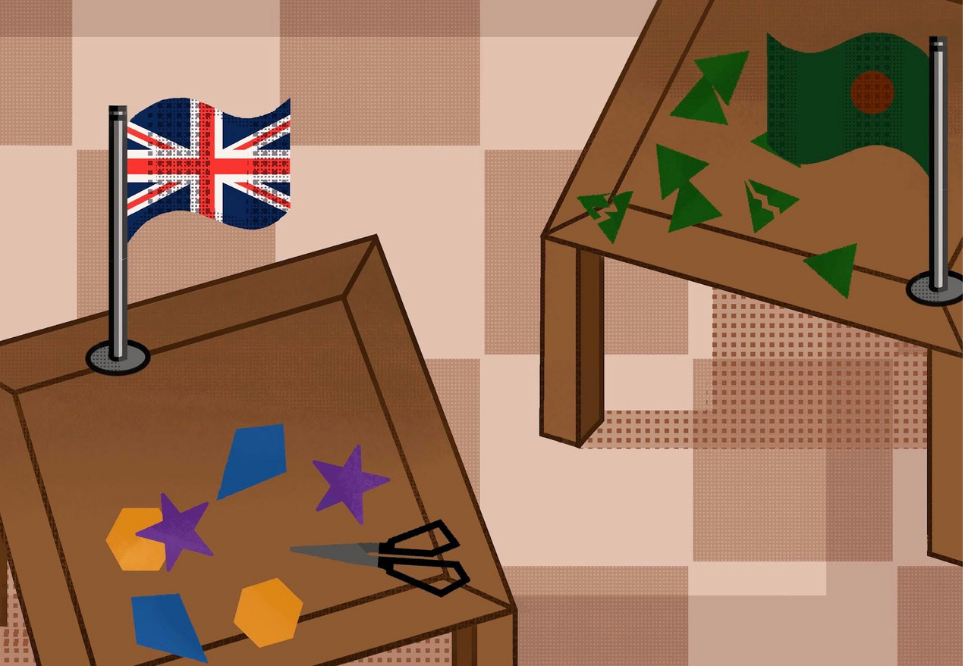
Snip snip snip. The British team utilizes their large amount of stationery to precisely craft complex shapes: dodecahedrons, stars and kites. The Bangladeshi team with their large number of people frantically rips paper after paper apart into squares and rectangles. The clock ticks down. There are only two minutes left before the World Bank stops accepting shapes. Both teams jump up, finish with their final shapes and race to the two students representing the World Bank.
Neocolonialism is more present in the world than ever before. As the world becomes more globalized and connected, more and more trade happens between a multitude of countries. Students need to be educated on the importance of neocolonialism and its effect on impoverished countries. Jones’ AP Human Geography classrooms teach the theory early on. Sadly, in the chaos of the school year, the curriculum places more emphasis on the later units such as urban development and agriculture while memory of this important concept evaporates.
Jane Shapiro, a teacher’s assistant, said, “Like many topics in AP Human Geography, practically every topic we have to move on fairly quickly because there’s a high amount of very disparate subject matter that needs to be covered in the class… like it just has so much content in that class that it’s very hard to linger on any one issue.”
In a paper by the Internet Encyclopedia of Philosophy, they identified that neocolonialism is, in simple terms, the practice of making an impoverished state dependent on another, more wealthy state through economic influence with the goal of extracting raw materials, exerting influence over the regime and exporting manufactured goods to that country. This practice is very prominent in African countries, especially after colonialism left the continent in such a horrible condition that it could not govern itself without significant economic challenges.
According to The Tricontinental organization, more and more African countries now rely on international aid to keep their institutions running. In a 2014 report by Curtis Research, 198 billion dollars worth of resources were extracted from Africa while only 134 billion dollars of investments and loans flowed in. As this practice becomes more common, it’s important for students to learn the concept and its moral implications.
The Trading Game is a detailed, low-budget and highly interactive simulation of neocolonialism with teams that represent countries with different levels of economic development. Participants of the activity are divided into four to six teams with unique advantages and disadvantages. Each group has the ability to manufacture different paper shapes that have increasing value depending on their complexity using their stationery. The goal of the game is to make as much money as possible by the time the game ends through selling manufactured paper shapes.
Adaptable, fluid and planned, the simulation is an intuitive activity when done correctly. The Christian Aid website provides teachers with five essential documents laying the foundation for how the game works. Best of all, these documents are completely free to download, reducing the cost down to only the materials needed to play the game.
Teachers have the freedom to bring in a variety of events into the simulation to keep it interactive and interesting whether it be current events or history. For example, events that mirror the real world happening in recent history can help students understand the weight of the concept and how it affects them and their peers. Students, although bound by more structured rules, can also flex their creative muscles, as students can trade with other tables for the stationery required for the game.
One ex-student by the online alias “Trolligarch” recounts his experience in his Youtube video. “My geography class had a competition. There was only one way to win” when his geography teacher hosted this activity. He initially started on the Bangladeshi team and transferred to the UK team where he quickly learned of the advantages the team had in blueprints for more complex shapes.
An obvious negative consequence caused by this activity is the huge amount of paper wasted. Large stacks of paper in different colors are provided to each team in order to simulate natural resources. However, the deep understanding of neocolonialism is well worth a few pieces of wasted paper. Students gain a firsthand experience of the morally questionable practices of developed countries through a fun and accessible game. To mitigate the waste, teachers can use these scraps of paper for other projects, such as to add flavor to personal map projects or decorating the classrooms.
Another criticism of the game is its one-sided favor toward more developed countries. Lesser-developed countries have a hard time catching up in manufacturing capacity of more developed ones. This unfair game layout would in almost any other situation be bad game design. In The Trading Game though, it’s a key part of the simulation to teach students about inequality and impact of neocolonialism on poorer countries. If the teacher wishes, she can lessen the unfairness by gifting underdeveloped countries more of a chance by providing them with more natural resources in the form of paper. From there on, it’s up to the students to use their unique advantages in a pursuit of victory.
If you’re an AP Human Geography teacher here at Jones and want to enrich your students’ knowledge of neocolonialism, you should use this resource by Christian Aid.