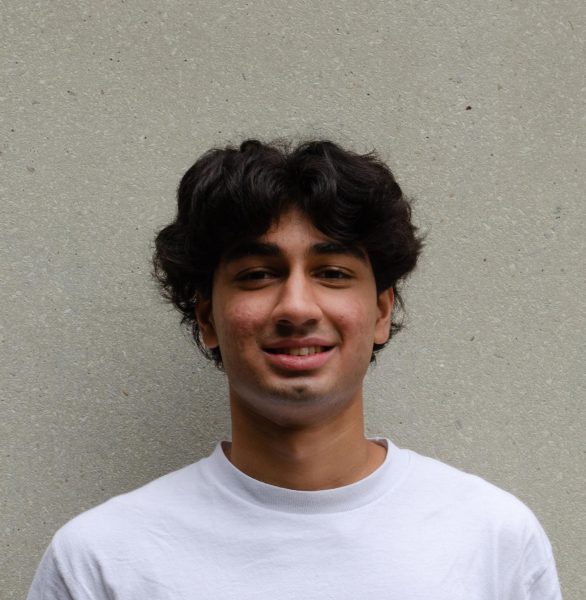
Since the Iran war began, Muslim, brown, and Iranian Americans have described stares, questions and comments. “I think people assume my position on this because of what I look like or where I’m from,” Parsa Koucheki, an Iranian American and senior at Jones, said. They said the attention has little to do with their identity, and rather with what they look like, what they believe in or where their families come from.
When war starts overseas, many Americans feel it in the news or in the economy. Whether it’s presidents addressing thenation or gas prices skyrocketing, all Americans are affected. But some people also feel it in other places, such as school, on the train or in the airport. Brown, Muslim and Iranian describe three different identities. Many people live in one, two or even all three. But the public often merges them into a single suspicion.
For Iranian Americans, the weight of the war is unbearable. Many wait for calls from relatives back home, knowing they may never hear from them again. With bombs flying over their relatives every day, news from back home comes in a quick, serious manner, rather than the joyful manner they once knew. Many also oppose the regime at war with the United States, with some leaving the country because of it. Even so, they still feel pressure to answer for it.
“I’m not a fan of the regime. It restricts political and personal freedoms for Iranians, all while putting their life in danger,” Koucheki said.
This community of Iranians holds many stories from many different angles. Iranian Americans include Muslims, secular families, Baha’is, Jews and Christians. They disagree about the war, the regime and how they should respond. Many fear that speaking out will endanger family at home, while others say that staying silent could signal support for the regime. Overwhelmingly, most say the hardest part is grieving for a homeland they feel powerless to help.
Most Muslim Americans have no Iranian heritage. Many come from South Asian, Arab, African American or convert backgrounds, and most have no ties to anything related to Iran. Despite this, many describe people treating them as though they do. “At times, people tend to assume I do have a stake in this war, but I don’t hold any strong political views towards it,” Riyaad Yaseen, a freshman at the University of Illinois Urbana-Champaign and a Muslim American, said.
Zain Moustafa, a former Blueprint deputy editor-in-chief and Muslim student, has covered the Iran war and related issues, watching the conflict from all sides.
“What originally drew me to write about Iran was that I felt like it was an important story that needed to be told, but it felt like nobody was really talking about it. I felt like it was easy for people to just read the headlines and see a war going on thousands of miles away with a country that most Americans have never visited,” Moustafa said.
Moustafa also noted that the media often leaves out lots of the nuance and opposing viewpoints that people have when it comes to this war.
“I think national media tends to view them as monoliths, where everyone is either completely for or completely against the war,” Moustafa said.
The label of being pro-Iran or pro-war often lands on people who are the complete opposite. South Asian, Arab and other brown Americans have long reported that others mistake them for whatever group the public currently fears.
“I think that there have been cycles where all Muslims have been sort of expected to be a representative on behalf of a certain country or group. Whether it be post-9/11, or now,” Moustafa said.
As Moustafa said, none of this started now. After Sept. 11, 2001, Muslims and those mistaken for Muslim faced a wave of harassment, surveillance and hate crimes. In 2025, the Council on American-Islamic Relations received 8,683 complaints of anti-Muslim discrimination nationwide, the most since it began publishing its annual report in 1996, according to the report as covered by Al Jazeera. Some say what sets this moment apart is how fast hostile content spreads online, often within hours. With the spotlight now on Iran, many are unsure whether to speak out or stay silent.
When asked what they wish their neighbors knew, their answers pointed to the same few things: they wanted people to stop making assumptions and to understand every side. Brown, Muslim, and Iranian identities share the same burden: answering for a war they didn’t choose. Blame for the war shouldn’t be placed upon regular citizens, but rather on the people who actually call the shots.
“We should be focusing more on the actual victims of this war, not the leaders spearheading it,” Yaseen said.