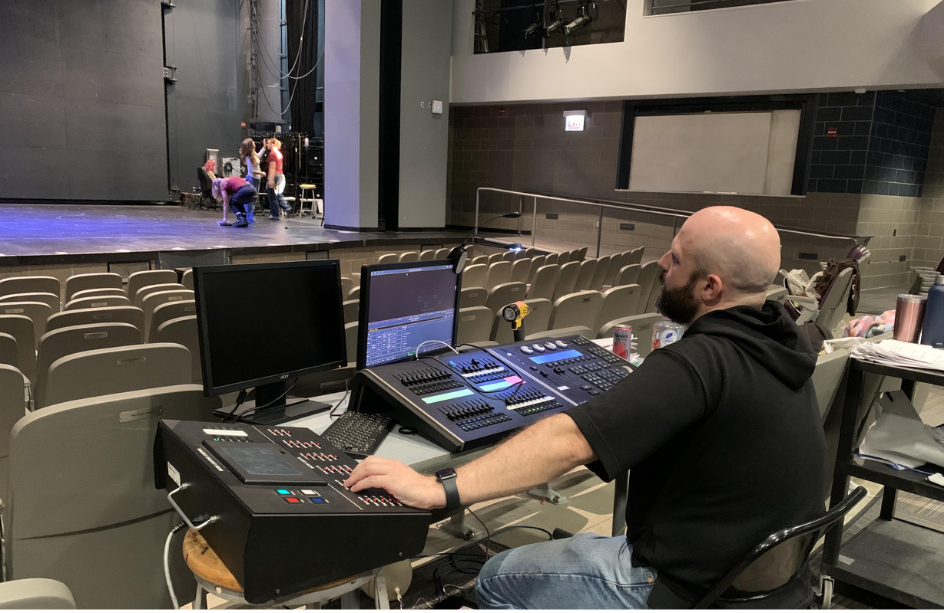
Where others see an empty stage, theater director Brennan Roach sees the end of the world — three different times. Now in his fifth full year teaching drama at Jones, Roach has spent the last month and a half putting together this year’s fall play, “The Skin of Our Teeth” by renowned playwright Thornton Wilder. Wilder’s Pulitzer Prize-winning three-part allegory for mankind follows the story of the Antrobus family in their fictional New Jersey town as they survive an ice age, flood and global war. While the play originally ran in the early 1940s, Roach has found his own ways to bring this classic story into 2026 and personalize it for Jones students.
“I’ve always had an imagination that kind of likes to wander,” Roach said.
Roach fell in love with theater when he was young, but despite his natural inclination toward performance arts, he admitted to hiding from it growing up because of peer pressure, especially while participating in activities like football and wrestling. However, after the choir teacher at his high school convinced him to audition for the musical, Roach knew he had found his calling.
“I find that this space is a really amazing place to work because it’s not dissimilar from dumping over your random bin of toys and kind of seeing what can happen when you put this and that together,” Roach said.
With “The Skin of Our Teeth,” he confessed that they “bit off a big piece” by tackling a play that brings global calamity thrice to the stage of our school’s South auditorium. Nevertheless, Roach has a vision.
Roman Hettrich, a senior, is playing the Fortune Teller in her fifth production so far at Jones.
“Something I love about Mr. Roach is that he thinks big, and he dreams big,” Hettrich said.
Student director Ruby Becker, also a senior, attests to this view of Roach’s ambitious visions.
“Roach usually has very specific images that we need to help broaden because they’re not always possible, but [he] always goes into his shows with a vision and is usually very good at achieving that,” Becker said.
With opening night scheduled for Nov. 12, Roach and a cast and crew made up of Jones students are in their final weeks of preparation.
“[‘The Skin of Our Teeth’] tells us a story of all these different moments that have happened throughout our lives, throughout history, where it seems like the world is coming to an end,” Roach said. “And somehow, some way, it doesn’t, right? And things keep going.”
While the play depicts literal, large-scale ends of the world, Roach means for it to also be about the smaller, less literal ends of the world that we all can relate to.
“How many times have we lived through something that’s deeply personal that feels like the end of the world, you know?” Roach said.
Becker shared her impression of what this play says about life.
“In current times, there’s a lot of talk about the end of the world and just things going wrong and things not working out,” Becker said. “This play really teaches us that even though things might be bad right now, there’s always a way to come back from it and start anew. I think that message is really important in today’s day and age.”
One of the obstacles that the theater department faced putting on this play was making it work in our modern world. Being written in the 1940s is part of its charm, but it also creates some challenges for Roach and the drama team to surmount.
“The only places that we’ve kind of trimmed around the edges there is if there’s things that did not translate from 1942 to 2026,” Roach said. “Like, ways of saying things or expressions.”
While the play generally transcends time, there are references to life back then that don’t quite resonate anymore.
“I think Roach is very much focused on making it relevant to current people so it doesn’t just feel like an old 1942 play,” Becker said. “But a lot of the student stage management is trying to find a really good balance between old and modern . . . it was written as 1942-modern, but we are altering it to make it more 2026-modern.”
When asked about how he plans to cater to not only a modern audience but a Jones College Prep audience, Roach explained that he defers to his band of student actors, directors and crew members to share their thoughts and impressions.
“The voices in the room,” Roach said. “I rely on that so heavily.”
Hettrich reflected on student voices that brought this play to life.
“I feel like everything is closer together than it ever has been,” Hettrich said. “This year especially, we’re doing a really good job of kind of bringing everyone together and making it clear that we’re all working on one project, and that we’re all important to it.”
In the end, Roach and the drama department are not in the business of telling audiences what to think of the play they put together; instead, they’re in the business of creating something that will intrigue and impact.
“I don’t want to say you have to feel this way about this play. I don’t even want to hope that people feel one way or another,” Roach said. “The thing that I do hope for, though, is that they walk away from the play asking questions and having a conversation about what they saw . . . Just to walk away a little more curious and a little more hopeful.”