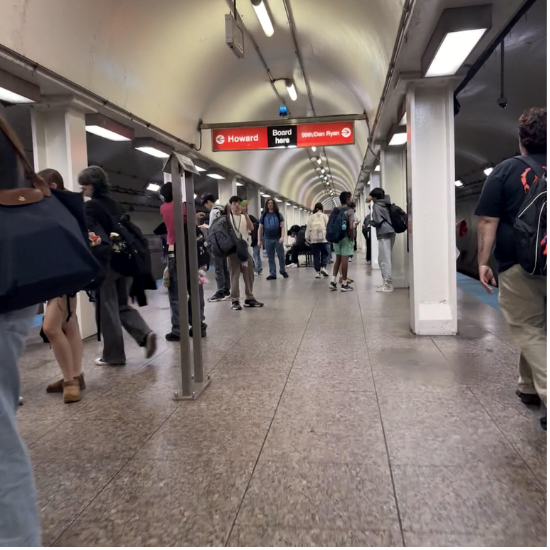
Any CTA rider can imagine 2 a.m. at Jackson station, with poor lighting and very few people around. Homeless people sleep on benches, and two of the turnstiles have broken, allowing for convenient fare evasion—especially with not a single security officer around to monitor them. Crime occurs often here with no one around to stop it.
A grand total of $1.2 billion has gone into the CTA, Metra, and Pace budget in the last year, as stated by the Northern Illinois Transit Authority, and, according to NBC News, $75 million of that went to CTA security alone. Meanwhile, the Illinois Interagency Task Force on Homelessness plans to spend only half that budget, $620 million, on combatting homelessness in 2026, according to Capitial City Now.
With Dec. 2025 came a dramatic rise in funding for CTA security, and law enforcement has dominated most major CTA stations with promises of decreasing crime. And, while reports have shown a drop in violent crime, increased security has drawbacks, with the city neglecting to address real causes of problems on the CTA such as mental health issues, addiction, homelessness and failing to provide consistent police security.
Other kinds of crime remain just as prevalent from before the funding increase, including victimless and property crime.
Increased security focuses on protecting people who take the CTA, which includes a significant portion of students from all across the city, with a heavy spotlight on Jones, located in the hub of public transportation—downtown Chicago. Safety remains a top priority for students who rely on the CTA to get to and from school, and since security continues lacking, especially with so much money pouring in, students stay at risk.
All this funding would have more benefits in addressing root causes of crime on the CTA, like mental health issues, addiction and homelessness, which not only drive perpetrators to commit violent acts but also make up the leading causes of crime in the entire U.S.
To fix these issues, the Chicago Transit Authority proposed to increase police patrol hours, have deputies on trains, and introduce new fare enforcement measures to reduce fare evasion, according to Block Club Chicago.
However, people don’t jump the turnstiles or sneak past the bus driver just for the fun of it—they do it because they don’t have the money to pay the fare. An increase of security for turnstiles does nothing to solve the root problem of poverty and homelessness; it merely ensures people will have to get craftier with figuring out how to take the CTA without paying the fare that many still cannot afford.
The issues on the train require more than just additional police. Other services, like mental health intervention, need more help than extra police officers can offer.
So, the money that goes to the increase of officers actually only goes to having guards confiscate a couple cigarettes or kick off an offender every now and again. This does nothing to prevent these people from simply hopping on another bus or train and doing it again.
Meanwhile, money aimed at a more worthy cause, such as substance abuse or criminal institutions, would address the core reasons behind these issues and ensure that they don’t happen again.
Often, security officers operate at major stations at all the wrong hours and for the wrong groups. Little threat exists at 1 p.m. when no one’s on the platforms, and yet security dominates stations. But during the night as people end late shifts or return from a concert, officers become far and few. That’s where the real danger is, but the police officers who have become necessary to ensure safety rest for their morning shifts, during which few would dare to commit any crime.
“A couple days ago I saw a man peeing on the train, and no one was stopping him. That seems like something security should be stopping, especially when it’s a threat to my safety and hygiene,” Caroline Price, a sophomore, said.
Even the money that should go to helping people in need on the CTA isn’t effectively tracked. Hundreds of officers’ schedules aren’t properly managed so as to ensure security stays exactly where it’s needed, when it’s needed to prevent the most harm.
All this money ends up going to a cause where it not only does a miniscule amount to help address the root problems but also fails in the areas where it’s supposed to benefit, like the number of on-duty officers.
The problem here isn’t with the funding going toward CTA security. Rather, it’s with the specific spending of that money. To make the CTA safer, money should go to stopping the problems before they happen by helping stop mental health issues, addiction and homelessness.
The Dec. 2025 proposal does have its benefits, though. Additional officers provide more consistent security than the previously used private security officers. They allow for rapid response to panic alert buttons on trains and can hold offenders accountable for property damage, vandalism, fare evasion, harassment of riders and CTA workers and other violations, according to the Chicago Tribune.
Security officers from private companies, who worked for the CTA up until the new policy, didn’t have the jurisdiction to make arrests or carry guns. So, police officers do show an upgrade from that. The CPD has the ability to escort people off trains and buses, and there’s the additional fear factor of an officer with a gun.
Therefore, CTA security appears to head in the right direction, but the system continues with its poor management. Until all this funding receives better distribution to target the underlying reasons behind crime, the CTA will remain unsafe, especially for students and other young people.
“When I get on the train, I want to be able to not worry that I’m not gonna get harmed. Especially when I’m going to school and am not super alert,” said sophomore Adrian Bautista.
The CTA needs to find the balance between overwhelming security that only solves short-term problems and no security at all. And with an increased budget and student advocacy for their personal safety on the CTA, it’s time to make changes. Students need to step up and make clear that safety on the CTA remains a top priority, and settling for mediocre police security isn’t enough.