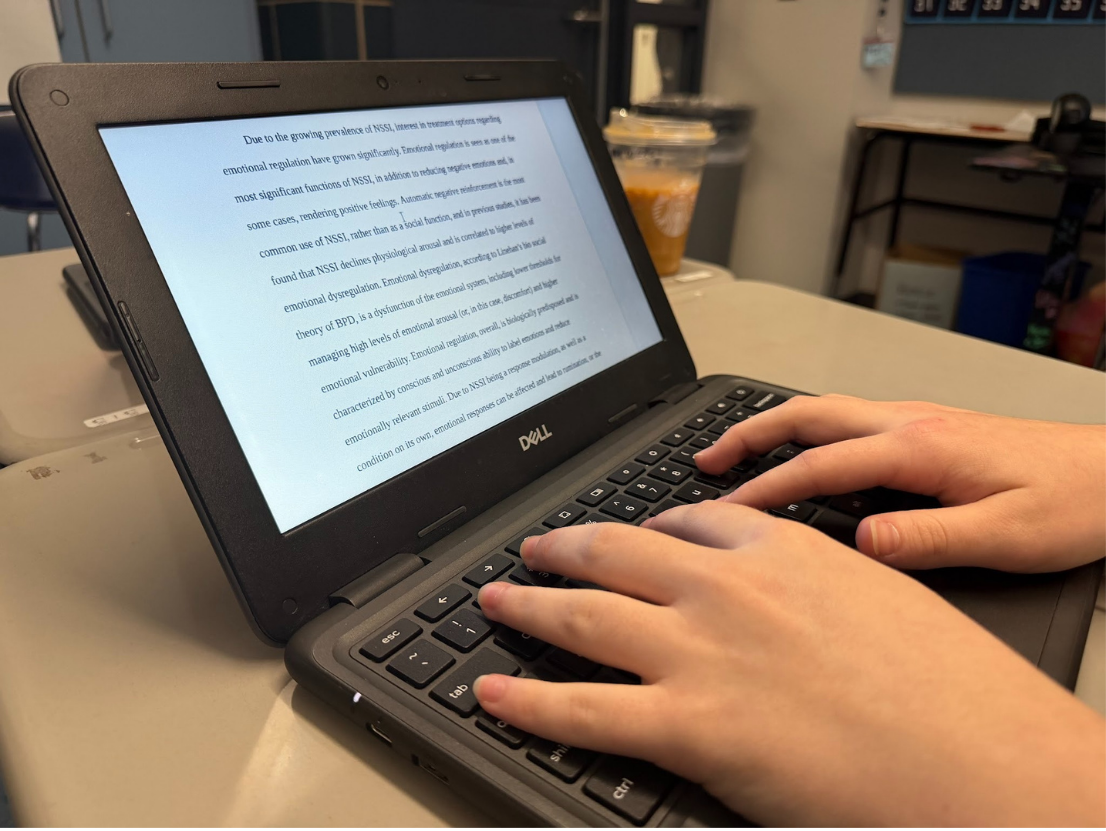
After scrolling for hours through several 30-page-long research papers, Zoe Meyer, a senior, struggles to find useful sources to support her own distinct research question.
AP Research students, much like Meyer, rely on sources, researchers and other professionals for the success of their research. They need to address the issue of a topic that will result in zero to minimal conclusions or solutions early into the year. In AP Research, the importance of time means utilizing a lot of outside help to help drive the research in the right direction. Meyer, despite using her time efficiently, got the short end of the stick after the removal of a program that would benefit her research.
According to Caitlin Miller, an AP Research teacher of 11 years, Jones used a mentor program that ran through the Illinois Science and Technology Coalition, which paired mentors — professors, graduate students and researchers — with AP Research students. This service allowed students to work with experienced mentors throughout their research journey. For the 2026-2027 school year, however, the service went on hiatus, and current AP Research students cannot access it.
“At the end of last year, I was concerned about the budget because CPS doesn’t have a lot of money,” Miller said. “I was concerned that we wouldn’t be able to have the program.”
With more students taking AP Research this year, the concern over whether classes can access the mentor program still existed regardless of the hiatus.
Meyer entered the new school year excited for this research opportunity, only to feel disappointed by the removal of the program.
“I kind of wanted to see how the hormones in fish could connect to human hormones, but it wasn’t feasible,” Meyer said.
Now a more independent process, AP Research students can no longer seek professional help from mentors in accessing resources. They now turn exclusively to research-publishing websites such as EBSCO and Google Scholar to find background information or important context on their topic. With the scarcity of resources and time, Meyer changed her topic to women’s menstrual cycles and how they affect voting decisions or political views, a topic entirely different from her original idea and much simpler.
“Instead of doing the topic I’m doing now, I would have slightly pivoted my original topic if I had the guidance of a mentor,” Meyer said.
Sophia Ziegler, a senior and AP Research student, experienced similar struggles with her research. Ziegler’s original research topic also related to marine life and the ocean, with an experiment-heavy methodology. However, due to infeasibility, she switched to an observational study instead, now studying golfers views on groundwater depletion and water conservationism.
“After not being able to do my original topic, I picked a topic that was 10 times easier,” Ziegler said. “But I know that a professional who does this for life would probably be able to help me out more.”
Meyer and Ziegler both attributed their switched topics to this year’s removal of the mentor program, believing they could still do their original research ideas if given the opportunity to collaborate with a professional.
“I’m a very outgoing person, so I reached out to people at the Shedd Aquarium and at hospitals,” Meyer said. “But I know a lot of people aren’t. A lot of people in my class haven’t been able to do certain things because they don’t have a mentor.”
Students experience the consequences of this removal to a different extent than teachers. Although students feel negatively about the shift, teachers hold confidence in the abilities of students.
“I was worried that it might [impact the students], but so far I haven’t seen that to be an issue,” Miller said. “They are a great group of seniors, and they’re doing a really good job.”
Although Miller agrees that AP Research students would benefit greatly from the experience of working with a mentor, her thoughts on the situation differ from the students’. AP Research students who spent their summers and time researching their original topics now feel pressured by the sudden switch in topic and methodology. Even with a new interest in a different topic, the students do not feel as engaged as they would with their original research.
“I still like my topic, it’s just not something that I wanted to do as much,” Ziegler said. “I was a lot more excited to do my original idea.”
Although students impacted by the program removal managed to get back on track, they still think about the opportunities it could offer them if it still existed.
“I was really looking forward to talking to a professional in the field. How it affected me was I didn’t get to learn from an expert, and it leaves more things on the students,” Meyer said.