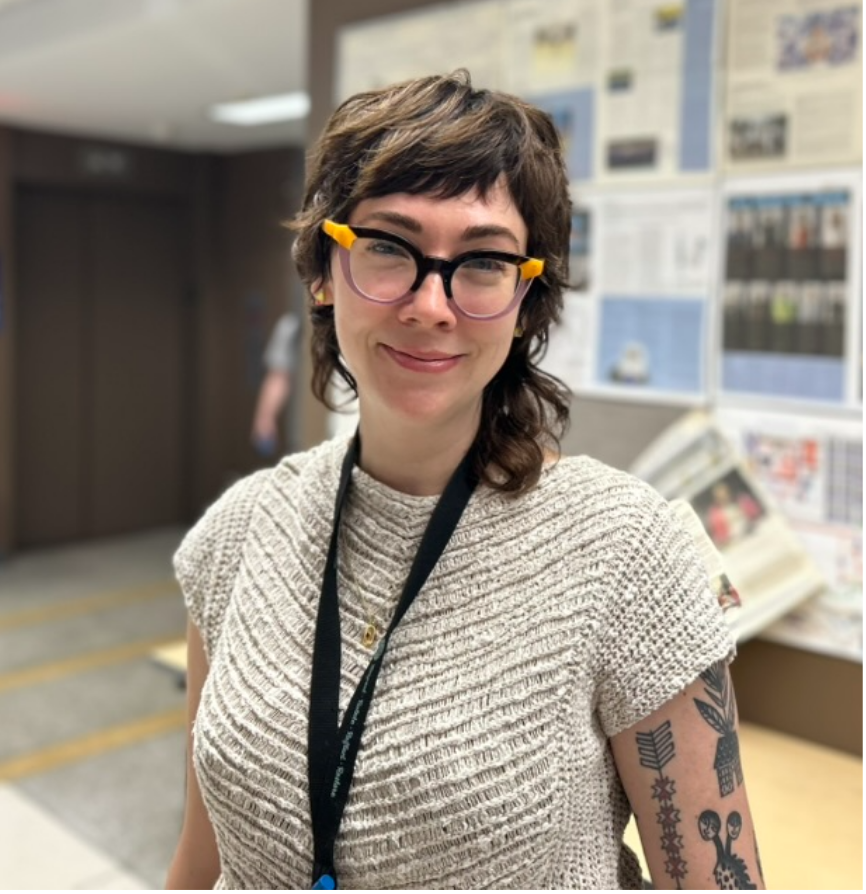
When schools shut down and streets emptied in the wake of COVID-19, history teacher Jennie Harned felt a creative itch. With the eternal nothingness of lockdown staring her down, she started to sew. And she began to knit. Soon, she had a daily artistic regime under her practice just about every day of quarantine.
But many creative regimens were shed after COVID-19 lockdowns were eased, and the populace returned to their daily routines. Not for Harned, however. The itch stayed with her. A longtime bulwark of the Jones Social Studies and History team, Harned began looking into the qualifications she would need to become an art teacher for Chicago Public Schools. To her surprise, she wouldn’t need to do much.
“CPS said, if I just took three more college classes, then I would be qualified to teach art,” said Harned.
It did not feel like enough to Harned, however, to just take three more classes after all her time in the teaching profession.
“It had been 20 years since I’d taken a foundational drawing class. I was like, I should probably go back in case I needed to teach that,” said Harned.
Harned spent her time with the City Colleges of Chicago learning the discipline of art, but found that being a student once again opened her eyes to much more.
“I think I had forgotten what the daily grind of being a student is, and just like how the entire facility or institution is built to serve the students, who don’t have the same conveniences that teachers have,” said Harned. “I didn’t have a refrigerator or a microwave for my lunch. I had to think about what kind of lunch I was bringing… it was a really good reminder of all the responsibilities.”
Now, a few months removed from her graduation, she’s ready to tackle the school year with fresh eyes.
“I don’t want to demand a lot of their attention outside of class. So I’ve really scaled back my thinking on homework to try and make it as minimal as possible… while still keeping the class rigorous and engaging,” said Harned.
Despite her time away, Harned wants to keep her history classes focused on history, even with a new perspective.
“It does feel perhaps like a bit of a bait and switch if I were to put too much art as a summative assessment or art as an element of grading a class that is about social sciences,” said Harned.
However, Harned finds that there is always a place for art history to be intertwined with social studies.
“I feel like I’ve always found ways to bring at least art and art history into my classroom without making it an art class,” said Harned. “I feel like art has always been [a thing] I’ve brought into my classroom in some shape or form.”
Looking beyond her previous practices, though, Harned does feel that itch to bring more physical materials into the history environment.
“I would love to be able to have more physical art elements in my classes, but there’s a couple of things that keep me from doing that,” said Harned.
After graduating, Harned found a way to scratch that artistic itch as a teacher outside of Jones.
“I have been teaching art classes, just not in CPS. I’ve been finding ways to get to do that,” said Harned.
Notably, though, Harned came back to school a history teacher, outside of the discipline she spent a year learning.
“There were a lot of things that made me miss the social sciences,” said Harned. “When the sabbatical was wrapping up and I was making my choice of what my next move would be, it was really easy to decide.”